If you’ve ever walked into a guitar shop and felt paralyzed by a wall of acoustic guitars — all of them looking roughly similar, with price tags ranging from $150 to $600 — you’re not alone. An acoustic guitar is, at its simplest, a hollow wooden box with strings. But the type of wood, and how it’s constructed, determines whether that box produces a rich, resonant sound that gets better with age or a flat, papery tone that plateaus the day you buy it. The single most important construction decision in this price range is whether the guitar has a solid top — meaning the face of the guitar (the part that vibrates and projects sound) is made from a single, real piece of wood — versus a laminate top, which is multiple thin layers pressed together, similar to plywood. That distinction, more than any other, is where your money is doing real work. This guide will show you exactly where the line is, which guitars sit on the right side of it, and how to match the right instrument to where you are right now as a player.
Why the Solid-Top Cutoff Matters More Than Any Other Spec
Here’s the core tradeoff in plain terms: laminate tops are stable, moisture-resistant, and cheap to manufacture. They’re genuinely fine for a beginner who isn’t sure they’ll stick with the instrument. But they don’t open up — they don’t develop tonal complexity as they’re played and as the wood dries and settles over months and years. A solid top does. The physics are simple: a single piece of wood vibrates as one cohesive unit, responding to string energy in a way that complex, layered plywood cannot replicate.
Sweetwater’s acoustic guitar buying guide frames it directly: a solid top is the single most impactful upgrade available to a player in the sub-$600 range, outweighing differences in electronics, hardware, or even tonewoods. Acoustic Guitar Magazine’s tonewood coverage reinforces that point — the marginal improvement from laminate back-and-sides to solid back-and-sides is real but modest in this price range, while the top is where the acoustic energy originates and where quality investment pays the biggest return.
The practical market reality in mid-2026: The solid-top threshold has drifted upward slightly with materials and labor costs. In 2020, you could reliably find all-solid guitars at $399. Today, the floor for a trustworthy all-solid instrument from a reputable brand sits closer to $499–$599. Solid-top-only builds (solid top, laminate back and sides) remain available from $250–$450 from Yamaha, Fender, and Seagull — and for most players in this tier, that’s the smart buy.
By the Numbers: What Your Budget Actually Buys
| Price Range | What You Typically Get | Tonal Ceiling |
|---|---|---|
| $150–$249 | Laminate top, laminate back/sides, basic nut/saddle | Plateaus quickly; fine for learning |
| $250–$399 | Solid top, laminate back/sides, improved hardware | Opens up over time; viable for gigging |
| $400–$499 | Solid top, quality laminate or solid back/sides, better nut material | Noticeably more complex; recording-capable |
| $500–$600 | All-solid construction or top-tier solid-top builds, bone nut/saddle | Competitive with guitars at 2x the price |
The Guitars Worth Talking About in This Range
Rather than delivering an exhaustive list, here’s a decision-frame approach. Guitar World’s 2025 roundup and MusicRadar’s ongoing coverage of acoustic guitars under $600 consistently surface the same small group of instruments. Here’s how to read the field:
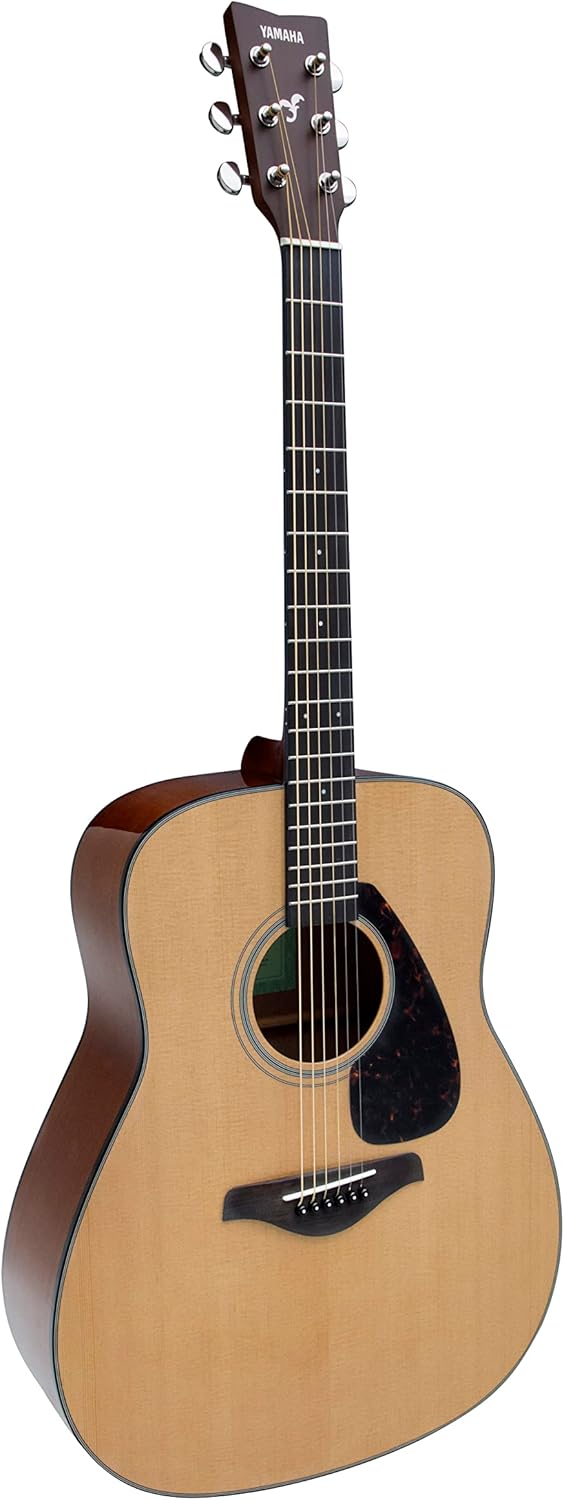
The Yamaha FG800 (~$200): The Benchmark Laminate Killer
The FG800 is the guitar that defines the top of the laminate tier and makes the case for spending a little more. It features a solid Sitka spruce top — Sitka being the most common acoustic guitar top wood, prized for its stiffness-to-weight ratio and clear articulation — over laminate nato (a mahogany substitute) back and sides. At around $200, it is, per MusicRadar’s analysis, the most consistent value proposition in entry acoustic guitars currently on the market.
Buy this if: You’re a beginner or returning player who wants a solid top without gambling more than you’re ready to commit. You’ll grow into it. It’s not a guitar you’ll be embarrassed to pull out at a campfire or a casual jam in two years.
The tradeoff: The laminate back and sides limit the low-end warmth and overtone complexity. It’s a bright, articulate guitar — great for strumming and folk — but it won’t satisfy a fingerstyle player chasing that warm, layered Martin sound.
The Seagull S6 Original (~$399): The Inflection Point
Seagull is a Canadian brand (owned by Godin) that consistently delivers all-solid construction at prices that make other manufacturers look careless. The S6 Original has a solid cedar top — cedar is softer and warmer than spruce, projecting with less right-hand effort, which makes it a fingerpicker’s favorite — with solid cherry back and sides. That’s all-solid construction at under $400, which in 2026 is genuinely uncommon.
Acoustic Guitar Magazine’s player reviews consistently describe the S6 as a guitar that “punches dramatically above its price class,” with owners noting the cedar top’s responsiveness to light picking dynamics. The wider nut width (1.8 inches versus the standard 1.6875 inches on most guitars in this range) is also notable: it gives fingerstyle players more string separation, which reduces the chance of accidentally muting adjacent strings.
Buy this if: You’re a fingerpicker, a singer-songwriter who plays with nuance, or anyone who wants all-solid construction and is willing to trade some strumming brightness for warmth and dynamic sensitivity. This guitar will genuinely reward better playing as your technique develops.
The tradeoff: Cedar scratches and dents more easily than spruce. If you’re a hard strummer, a touring musician who doesn’t baby gear, or someone who plays with a pick in loud rooms, spruce is more forgiving and durable long-term.
The Fender CD-60S (~$249): The Honest Workhorse
The CD-60S is Fender’s answer to the FG800, and in most head-to-head coverage — including Guitar World’s 2025 buying guide — it trades blows favorably at a similar price. It also features a solid spruce top over laminate back and sides, with a scalloped (curved) X-brace pattern inside the body. Scalloped bracing — meaning the internal wooden struts that hold the top in shape are relieved (carved thinner) at intervals — allows the top to vibrate more freely, producing more volume and a livelier tone than standard bracing at the same price.
Owners across long-run reviews frequently mention its playability out of the box — lower action (the height of the strings above the fretboard, which determines how hard you have to press) than many competitors without a professional setup.
Buy this if: You want a strumming guitar, you play with a pick most of the time, and you want the confidence of the Fender name in a room where that still signals something.
The tradeoff: Back and sides are laminate mahogany, and Fender’s acoustic quality control in this range has drawn occasional criticism in owner reviews for inconsistency from unit to unit. Buy from a retailer with a solid return policy.
The Yamaha AC3R (~$599): Where This Range Hits Its Ceiling
If your budget reaches $599 and you’re a serious player — gigging semi-professionally, recording at home, or building a signal chain you expect to keep for five or more years — the Yamaha AC3R represents a different class of instrument. It features all-solid construction (solid spruce top, solid rosewood back and sides), a bone nut and saddle (bone transmits string vibration more efficiently than the plastic used on most budget guitars, with owners consistently describing improved sustain and note separation), and Yamaha’s SRT2 pickup system for acoustic-electric performance.
MusicRadar’s acoustic guitar coverage notes the AC3R as one of the few instruments under $600 that competes on playability and tone with mid-market guitars in the $800–$1,000 range.
Buy this if: You’re a working or semi-professional player who needs one guitar to handle live performance, home recording, and serious practice. The pickup system, all-solid construction, and bone nut justify the price as a complete, long-term instrument.
The tradeoff: At $599, you’re at the ceiling of this guide’s range. For $200–$400 more, you enter Martin 000-15M territory — all-mahogany, all-solid, career-grade. If you’re genuinely serious and your budget can stretch, that conversation is worth having.
The Setup Variable Nobody Talks About Enough
Here’s a piece of information that doesn’t show up in most buying guides: factory setups on guitars in this price range are inconsistent, and a professional setup ($50–$80 at most local shops) can transform the instrument. Action that feels stiff or buzzy out of the box is often a nut and saddle adjustment, not a fundamental flaw in the guitar. Sweetwater’s acoustic buying guide explicitly recommends budgeting for a setup when purchasing in this range.
If you’re buying online — which makes sense for price and selection — build the setup cost into your budget from the start. A well-set-up $300 guitar will outplay a poorly set-up $500 guitar every time.
The Decision Rules: If X, Then Y
This is where the analysis earns its keep. Here are clean decision frames based on your actual situation:
-
If you’re a beginner or returning player with a $150–$250 budget: Buy the Yamaha FG800 or Fender CD-60S. Get a setup done. Don’t let anyone sell you on a laminate-top guitar at $300 when these solid-top options exist at $200.
-
If you primarily play fingerstyle or favor warm, gentle dynamics: The Seagull S6 Original’s cedar top and wide nut are purpose-built for you. Spend the $399.
-
If you strum hard, play with a pick, or need durability on the road: Spruce over mahogany (FG800, CD-60S) handles abuse better. Cedar is beautiful but softer.
-
If you gig live or record at home and need an acoustic-electric (a guitar with a built-in pickup for plugging into a PA system or audio interface): The Yamaha AC3R at $599 is the honest answer at this price ceiling. Don’t buy a cheap soundhole pickup as a workaround — the AC3R’s integrated system is a different category of result.
-
If your budget is $500–$600 and you’re not sure whether to buy the best guitar in this range or stretch to $700–$800: Stretch. The Martin 000-15M, the Yamaha LL16, and the Taylor Academy 12 all sit just above this range and represent a genuine step-change in long-term satisfaction. Don’t let round-number thinking trap you at the ceiling of a tier when the floor of the next tier is close.
The acoustic guitar market in 2026 rewards research, and you’ve done the work. The solid-top cutoff is real, the instruments above are honest, and any one of them — properly set up and matched to your playing style — is a guitar worth growing into.