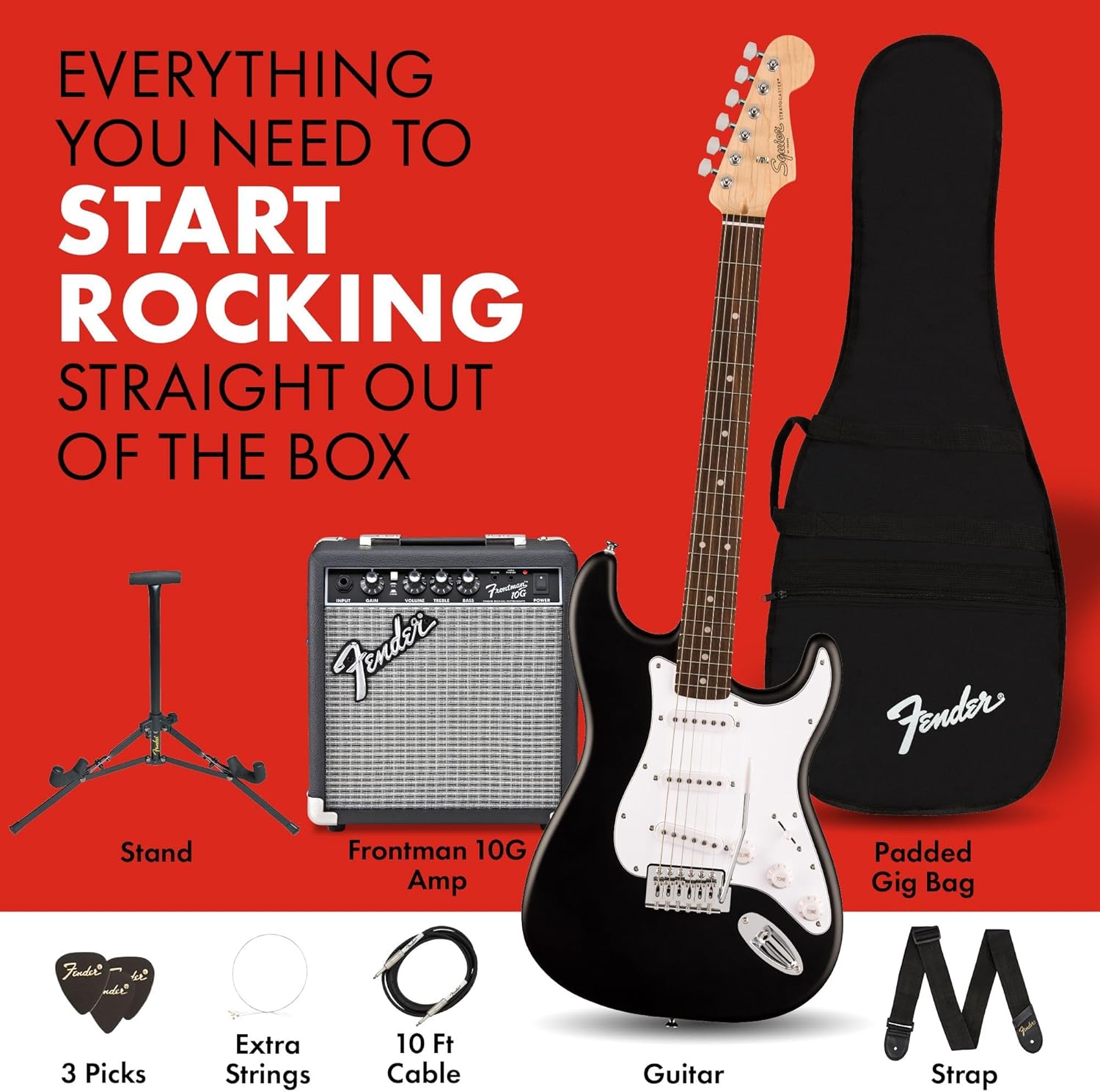
You’ve been playing for a little while now — maybe on a hand-me-down, a cheap holiday bundle guitar, or a starter pack you grabbed when you weren’t sure this whole guitar thing would stick. It stuck. Now you’re ready for the real step up: your first serious electric guitar setup, which in the guitar world usually means a guitar-plus-amplifier kit (sometimes sold together, sometimes assembled piece by piece) that will actually grow with you. A good beginner electric guitar kit typically bundles a solidbody electric guitar — a guitar built around a solid piece of wood rather than a hollow resonating chamber, which makes it louder through an amp and easier to control — with a small practice amplifier, a cable to connect them, and basic accessories. Getting this combination right matters more than most first-time buyers realize. The wrong pick and you’re back at the gear store in a year. The right pick and you’re still playing that guitar a decade from now.
This guide is written for the player who is done guessing. You know an open chord from a barre chord. You’ve heard the words “Stratocaster,” “humbucker,” and “single-coil” thrown around and roughly know what they mean. Now you want a straight answer: what should I actually buy, and why?
Why “Beginner Kit” Doesn’t Have to Mean “Starter Junk”
The beginner guitar market has changed significantly. According to Guitar World’s roundup of best beginner electric guitars, the $150–$400 price window now contains instruments that would have been considered intermediate-quality just ten years ago. Squier (Fender’s more affordable line), Epiphone (Gibson’s), and Yamaha have all moved manufacturing quality upward at the entry level.
Here’s the honest version of what that means for you:
The guitar itself matters most. Amps in beginner bundles are almost always the weakest link — they’re serviceable for practicing at home but not much more. The guitar, on the other hand, can be a genuinely good instrument if you pick carefully.
Setup matters as much as the model. Per Premier Guitar’s overview of budget guitar setups, a $200 guitar with a proper professional setup (adjusting the action — the distance between the strings and the fretboard — and intonation) can play better than a $400 guitar still in factory spec. If you buy from a music store that includes a setup, or budget $40–$60 for one after purchase, you’re already ahead.
Pickups are the engine. Pickups are the magnetic devices under the strings that convert your picking into an electrical signal your amp can play back. Single-coil pickups (the slim rectangular ones, associated with Fender Stratocasters and Telecasters) sound bright and clear, with a slight hum. Humbuckers (the wider double-coil pickups, associated with Gibson Les Pauls and many Epiphones) are warmer, thicker, and quieter. Neither is objectively better — it depends entirely on what music you want to play.
The Decision Framework: Four Questions Before You Buy
Before naming specific models, here’s the decision tree that actually determines what you should get. This is where most buyers go wrong — they pick based on looks, then regret the tonal mismatch six months later.
1. What music do you want to play?
This is the single most clarifying question. Be honest with yourself.
- Blues, classic rock, indie, country, pop: You probably want single-coil or a guitar with both pickup types (called HSS — Humbucker-Single-Single — or SSS). The Fender Player Series review over at MusicRadar consistently points to the Squier Affinity Stratocaster as the entry-level benchmark here.
- Hard rock, metal, punk, grunge: You want humbuckers or a guitar wired for high-gain sounds (high-gain means distortion with a lot of crunch and sustain). The Epiphone Les Paul Standard and Squier Affinity Telecaster Deluxe both show up repeatedly in MusicRadar’s roundups as overachievers at this price range.
- I don’t know yet: Get an HSS Stratocaster-style guitar. It covers the most ground.
2. What’s your honest budget — all in?
“All in” means guitar + amp + cable + picks + strap + tuner. People forget the accessories and then feel short-changed when they can only afford a $79 amp because they blew their whole budget on the guitar.
By the Numbers:
| Budget | Guitar Target | Amp Target | What You’re Getting |
|---|---|---|---|
| $250 total | $150–$175 guitar | $40–$60 amp | Squier Affinity tier; functional, limited amp |
| $400 total | $200–$250 guitar | $80–$100 amp | Sweetspot tier; Squier Classic Vibe or Yamaha Pacifica |
| $600 total | $300–$350 guitar | $150+ amp | Significant quality jump; Fender Frontman 20G or Blackstar Fly |
3. How loud can you actually play?
If you’re in an apartment, a dorm room, or a house where other people are trying to sleep before 10 PM, a 40-watt amp is overkill and potentially a problem. Sweetwater’s electric guitar buying guide specifically calls out the 10–20 watt range as the practical sweet spot for home practice — loud enough to feel real, quiet enough for shared spaces.
4. Are you planning to play with other people within a year?
If yes, buy the better guitar and the cheaper amp now. Amps are easier to upgrade incrementally. A quality guitar body and neck will serve you through multiple amp upgrades.
The Tiers, Named and Mapped
Tier 1: The $200–$300 All-In Kit (Budget Serious)
Best fit: You’re genuinely uncertain whether you’ll stick with it, or you’re buying for a teenager who might stick with it, or money is tight and you want to test the waters without regret.
The Squier Affinity Strat HSS pack is the benchmark at this level. Guitar World reviewers consistently describe the Affinity line as the point where Squier became a real guitar rather than a toy, noting the improved fretwork and resonant alder bodies introduced in the 2021 redesign. The included Frontman 10G amp is underpowered for anything but bedroom practice, but at this price that’s the trade. The guitar itself is not a placeholder — owners report keeping Affinity Strats as secondary instruments years after upgrading their main rig.
Buy this if: Budget is the primary constraint, you’re not sure about the genre yet, or you’re buying as a gift.
Tier 2: The $300–$500 All-In Kit (The Real Sweet Spot)
Best fit: You’ve played for six months or more, you know what music you want to play, and you want a guitar you won’t feel embarrassed bringing to a friend’s jam session.
Two instruments dominate this tier for good reason:
Yamaha Pacifica 112V — repeatedly cited by MusicRadar and Sweetwater as one of the best value propositions in electric guitar history. The 112V features an alder body, a maple neck, a rosewood fretboard, and an HSS pickup configuration that covers clean to crunchy convincingly. Owners across aggregated long-form reviews consistently highlight the factory setup as notably better than competitors at this price. Pair it with a Fender Frontman 20G or a Boss Katana Mini (a small digital modeling amp that gives you multiple sound textures in one unit) and you have a rig that will last years.
Squier Classic Vibe ’50s or ’60s Stratocaster — one step above the Affinity, with vintage-voiced pickups that receive near-universal praise from reviewers at both Guitar World and Premier Guitar. These are not beginner guitars wearing a beginner label; they’re adult instruments priced accessibly. The ’50s maple fretboard version is especially recommended for players drawn to twangy country, classic rock, or surf sounds.
Buy this if: You’ve committed to playing seriously, you have a genre in mind, and you want a guitar you’ll still own in five years.
Tier 3: The $500–$800 All-In Kit (The “Don’t Hold Back” Entry)
Best fit: You’ve been playing seriously for six months or more, you’ve already outgrown one guitar, or you’re an adult returner (someone who played years ago and is getting back into it) who knows exactly what they want.
At this level, the conversation shifts from “kits” to “building your own kit.”
The Fender Player Series Stratocaster or Telecaster — made in Mexico, reviewed extensively by Sweetwater and Premier Guitar as the dividing line between student and professional territory — gives you a genuine Fender with proper pickups, reliable hardware, and a playability ceiling that professional musicians regularly keep in rotation as backup instruments. Pair it with a Fender Mustang LT25 or Boss Katana 50 MkII (a 50-watt modeling amp highly rated by MusicRadar for its usable built-in effects and realistic clean sounds at neighbor-friendly volumes) and you have a complete rig that requires no apology to anyone.
The Epiphone Les Paul Standard is the humbucker answer at this tier — thick, warm, ideal for blues, classic rock, and hard rock. Premier Guitar’s setup guide notes that Epiphone’s recent production improvements have narrowed the gap with Gibson’s own entry-level offerings considerably.
Buy this if: You’re serious enough that buying something lesser would feel like deliberately handicapping yourself. Don’t hold back here if the budget allows.
The One Setup Move Nobody Tells Beginners
Regardless of which tier you land in: get a professional setup before you judge the guitar. A setup — where a luthier (a guitar technician or repair person) adjusts the neck relief, action, intonation, and nut slots — costs $40–$75 at most music stores and transforms the playability of almost every guitar under $600. As Premier Guitar’s setup basics overview explains, factory action on budget instruments is often set conservatively high to avoid fret buzz (an unwanted rattling sound caused by strings vibrating against frets), which makes the guitar harder to play than it should be. One setup appointment closes most of the gap between a $200 guitar and a $400 guitar in terms of how it actually feels.
The If/Then Decision Wrap-Up
Here’s the clean version of everything above:
- If you’re on a tight budget and just want to get started: Squier Affinity HSS pack, $250–$300 all in. Buy from Sweetwater, Reverb, or Guitar Center where setup support is available.
- If you want the best value in the entire beginner market: Yamaha Pacifica 112V + Boss Katana Mini or Fender Frontman 20G, $350–$450 all in. This combination comes up again and again in Guitar World and MusicRadar reviews as the one nobody regrets.
- If you’re an adult returning player or committed beginner who won’t outgrow this setup: Fender Player Strat or Telecaster + Boss Katana 50 MkII, $700–$800 assembled. This is a working musician’s rig at a beginner price point.
- If you want humbuckers and classic rock warmth at any of these tiers: Substitute the Epiphone Les Paul Standard at the $400–$500 mark; it outperforms its price consistently across aggregated reviewer consensus.
The guitar you buy today sets the floor for everything you’ll learn to hear and feel. Spend thirty minutes with this framework, make the call, and go play.