If you’ve been playing guitar for a while, you’ve probably heard someone mention a “pedalboard” — that flat board covered in little boxes that guitarists stomp on to change their sound mid-song. Each box, called a pedal or stompbox, does something specific: one might add grit and crunch (distortion or overdrive), another might make your notes bloom and linger like you’re playing in a cathedral (reverb), and a tuner pedal keeps your guitar in pitch so you don’t sound like a broken clock onstage. Building a smart pedalboard is one of the most satisfying parts of developing as a player — and Boss, a brand that has been making stompboxes since 1977, is where most serious players start (and often finish). This guide breaks down four Boss pedals that show up on boards from bedroom studios to professional touring rigs: the DS-1 Distortion, the BD-2 Blues Driver, the RV-6 Reverb, and the TU-3 Chromatic Tuner. We’ll show you what each one actually does, where it earns its keep, and — critically — which one fits your specific setup.
Why Boss? The Case for Starting (or Staying) Here
Before we go pedal by pedal, it’s worth understanding why Boss dominates starter and mid-level boards in a way few other brands do. The answer isn’t marketing — it’s three things: build quality, standardization, and resale value.
Boss uses a proprietary “double-latch” enclosure that has been documented as essentially indestructible in standard use. Guitar World’s 2024 roundup of the best Boss pedals notes that the brand’s ABS plastic housing, reinforced at the switch point, routinely survives decades of live use. The footswitch mechanism is rated for 50,000 actuations — Sweetwater’s product documentation on the TU-3 and RV-6 cites this figure explicitly for both units. That’s roughly 137 stomps a day for a year without a hiccup.
Standardization matters too. Every Boss compact pedal runs on a standard 9V center-negative power supply — the same connector every other major pedal uses. You’re not hunting for a proprietary adapter. And if you ever want to move one on, Boss pedals hold value reliably on the used market; Reverb.com’s 2025 marketplace data consistently shows DS-1 and TU-3 units moving quickly with minimal price depreciation from their new retail price.
By the numbers — Boss compact pedals in 2026:
- DS-1 street price: ~$50 new | ~$25–35 used
- BD-2 street price: ~$100 new | ~$55–70 used
- RV-6 street price: ~$150 new | ~$90–120 used
- TU-3 street price: ~$110 new | ~$65–80 used
DS-1 Distortion — The $50 Pedal With a 45-Year Track Record
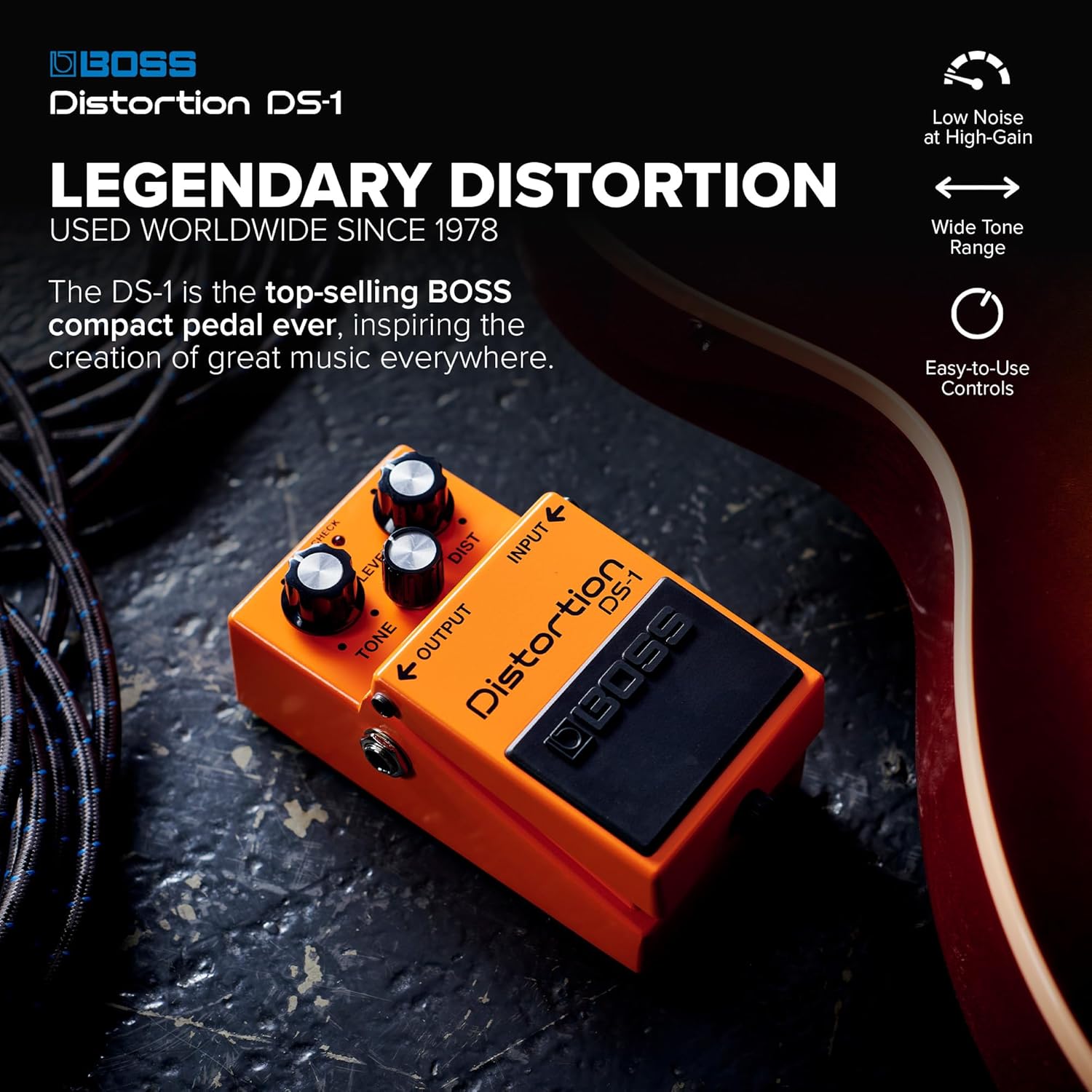
The DS-1 is one of the best-selling guitar pedals ever made. Full stop. Guitar World’s 2023 deep-dive on the DS-1 traces its lineage back to 1978 and points out that it has appeared on recordings by Kurt Cobain, Steve Vai, and Joe Satriani — three players whose tones are radically different from each other, which tells you something important: the DS-1 is a shape-shifter.
What it does is add distortion — a hard clipping of your guitar’s signal that produces the crunch and sustain (the ability to hold a note without it dying out) associated with rock, punk, metal, and grunge. Three knobs control everything: Level (how loud the effect is relative to your dry signal), Tone (how bright or dark the distortion sounds), and Dist (how much gain — how aggressive the effect is).
The tradeoff is texture. Owners consistently describe the DS-1’s distortion as “fizzy” or “sharp” at higher gain settings, which is exactly what made it perfect for Cobain’s Nevermind-era tone, but can feel harsh if you’re chasing smooth lead sustain. MusicRadar reviewers and longtime owners note that rolling the Tone knob back to around 10–11 o’clock tames the brightness significantly.
Buy the DS-1 if: You play rock, punk, or grunge and want a proven, affordable foundation. It’s also an excellent “always-on boost” for pushing a tube amp into natural breakup. If you need smooth, singing lead distortion for blues or classic rock, keep reading.
BD-2 Blues Driver — When Overdrive Needs to Breathe
The BD-2 Blues Driver occupies a different tonal space than the DS-1, and understanding that difference is the central decision point of this guide.
Where the DS-1 creates distortion by hard-clipping the signal (think of it as cutting the waveform’s peaks off sharply), the BD-2 uses a softer, asymmetrical clipping circuit that produces overdrive — a gentler, more organic breakup that responds to how hard you pick. Pick softly and the BD-2 stays relatively clean. Dig in and it starts to grit up. That dynamic responsiveness is what players mean when they say a pedal “breathes.”
MusicRadar’s review of the BD-2 calls it “one of the most touch-sensitive pedals in the Boss catalog” and notes that it interacts with your guitar’s volume knob in a way the DS-1 doesn’t — rolling your guitar’s volume down cleans the signal up almost completely. Premier Guitar’s coverage of pedal stacking (using two pedals together) has repeatedly flagged the BD-2 as an ideal “always-on” foundation pedal because it enhances tone without bulldozing it.
The BD-2 has a slight mid-scoop in its stock voicing — owners in long-run reviews note it can feel thin through smaller amps. A common fix is running it into a tube amp with its own natural midrange character, or stacking it with a clean boost pedal in front.
Buy the BD-2 if: You play blues, country, classic rock, or any style where you want your dynamics and picking nuance to come through. It’s also the call if you’re running it into a clean amp and want the overdrive to be the primary voice, not a supplementary crunch layer. If your amp is already dirty and you need more saturation on top, the DS-1’s harder character may actually complement it better.
RV-6 Reverb — Eight Modes, One Pedal, Gig-Ready
Reverb is the effect that makes a guitar sound like it exists in a physical space — a small room, a large hall, a cave, a plate-spring hybrid from a 1960s studio. Without at least a touch of reverb, a dry electric guitar in a live mix can sound clinical and lifeless. With too much, you’re playing underwater.
The RV-6 is Boss’s current flagship compact reverb, and it punches well above its price class. Premier Guitar’s 2016 review of the RV-6 — which remains widely cited because the pedal hasn’t been substantially revised — praised its Shimmer mode (which adds harmonic octave layers to the reverb tail) and its Modulate mode (which applies a gentle chorus-like movement to the reverb) as genuinely professional-quality tools, not just adequate approximations. Eight modes total cover:
- Room and Hall — the fundamentals, natural and clean
- Plate — the vintage studio sound associated with 1960s and ’70s recordings
- Spring — simulating the spring reverb tanks built into vintage amps like a Fender Twin Reverb
- Modulate — reverb with subtle pitch movement for texture
- Shimmer — ethereal, synth-adjacent reverb popular in ambient and post-rock
- Dynamic — a mode that pulls reverb back when you’re playing and lets it bloom in the spaces between notes
- +Delay — reverb and delay (a distinct echo effect) combined in a single pedal
Owners consistently report that the Spring and Dynamic modes are the most immediately useful for live playing — Spring for country and vintage rock tones, Dynamic for players who want ambience without muddiness at high tempos. The stereo output capability (running two outputs into two amps) is flagged by Guitar World as a significant value add that competitors at this price point rarely include.
Buy the RV-6 if: You’re building a board that needs to cover multiple genres, or you gig in varied venues where the room’s natural acoustic changes. It’s also the right call if you’re running into a Fender-style amp that already has a spring reverb tank — you can use the amp’s reverb for your foundation and the RV-6’s Shimmer or Dynamic modes for specific song moments. If you only ever need basic room or hall reverb, a less expensive reverb pedal might suffice, but the RV-6’s flexibility earns its price over time.
TU-3 Chromatic Tuner — The Pedal You Will Actually Use Most
The TU-3 is not glamorous. No one talks about the TU-3 at a dinner party. But ask working guitarists what single piece of gear they would never gig without and the TU-3 — or its predecessor, the TU-2 — comes up constantly.
A chromatic tuner detects the pitch of each string you play and tells you whether it’s sharp (too high), flat (too low), or in tune. The TU-3 does this faster and more accurately than most clip-on or app-based tuners, with a bright LED display readable under stage lighting. Sweetwater’s product documentation cites a tuning accuracy of ±1 cent (a cent is one-hundredth of a musical semitone — a very small unit), which is tight enough for professional use.
What makes the TU-3 indispensable for a pedalboard is its buffered bypass and built-in power supply output. Buffered bypass means the pedal keeps your signal strong and clean even when the tuner mode is off — an important consideration once your board grows beyond two or three pedals and long cable runs start degrading your tone. The 200mA power output can run other Boss compact pedals directly from the TU-3, reducing the number of power supply units you need on a small board.
Owners in long-run Sweetwater and Guitar World forum discussions consistently note that the TU-3’s mute function — the signal is silenced while you tune, so the audience doesn’t hear your retuning — is one of those features that seems minor until the first time you’re onstage and grateful for it.
Buy the TU-3 if: You’re building any board intended for live or rehearsal use. This is the rare gear purchase with almost no meaningful downside at its price. If you’re a home-studio-only player who tunes via a DAW (digital audio workstation) plugin or a separate rack tuner, it’s the one pedal on this list you can skip — but for anyone performing live, it’s the foundation the rest of the board stands on.
Putting It Together — Signal Chain and Decision Rules
If you’re buying all four pedals, the standard signal chain order is: Guitar → TU-3 → BD-2 or DS-1 → RV-6 → Amp. The tuner goes first so it reads the cleanest possible signal. The drive pedal goes before reverb so you’re reverberating a distorted signal, not distorting a wet one (distorting reverb creates a muddy wall of sound that obscures note definition).
Here’s the practical decision frame:
- If you play blues, country, or classic rock: DS-1 optional, BD-2 essential.
- If you play rock, punk, or metal: DS-1 essential, BD-2 optional or secondary.
- If you play multiple genres or gig regularly: own both drive pedals. At $50 and $100, together they cost less than most single boutique overdrive pedals, and they cover opposite tonal ground.
- If you’re on a strict budget: TU-3 → one drive pedal (BD-2 for versatility) → skip the RV-6 until later. A touch of reverb from your amp will hold you over.
- If you’re building a gigging board from scratch: all four are the correct answer. Under $420 new, this four-pedal setup competes with rigs that cost three times as much.
Boss’s catalog has remained stable at these price points through 2025 and into early 2026, making these some of the most predictable gear purchases in the market. They’re not the flashiest stompboxes you can buy — and that’s precisely why they’re on so many serious boards.