If you’ve ever heard Jimi Hendrix make his guitar sound like it’s talking, or felt that dreamy, swirling shimmer underneath a clean rhythm part — those sounds didn’t come from the guitar or the amp alone. They came from pedals. Specifically, from a category of pedals called modulation effects (effects that move, wobble, or shape your tone over time) and wah pedals (foot-controlled filters that sweep your frequency response, mimicking a vowel sound). Together with a third effect called phasing — which splits your signal, delays one copy slightly, and recombines them to create a swooshing, spacious effect — these three tools form the foundation of expressive lead and rhythm guitar tone across virtually every genre. This guide will break down how each one works, what separates a budget option from a premium one, and — most importantly — when to use each effect so it serves your music instead of cluttering it.
How Each Effect Actually Works (And Why It Matters)
Understanding the mechanics here isn’t just academic — it tells you why two pedals in the same category can feel completely different on a board, and helps you buy the right one the first time.
Wah
A wah pedal is essentially a bandpass filter (a circuit that emphasizes a narrow slice of your frequency spectrum) mounted under a rocker pedal so your foot controls which frequencies get boosted in real time. Rock the toe down and you push the high, bright frequencies forward. Heel down, and the warm low-mids come through. The vocal quality comes from sweeping between those positions while you play.
The original Vox Clyde McCoy wah from the late 1960s — the circuit that defined the effect — is still the benchmark most boutique builders reference. As Sweetwater’s “Modulation Effects Explained” knowledge base article notes, the key tonal variables in a wah are the inductor (the coil component that determines how wide or narrow the frequency sweep sounds) and the Q control (how sharply peaked or smoothed-out the filter sounds). Cheaper wah pedals use mass-produced inductors; more expensive ones use hand-wound or vintage-spec inductors that produce a wider, more vocal-feeling sweep. That’s not marketing — it’s measurable component-level difference, and players who’ve used both tend to feel it immediately.
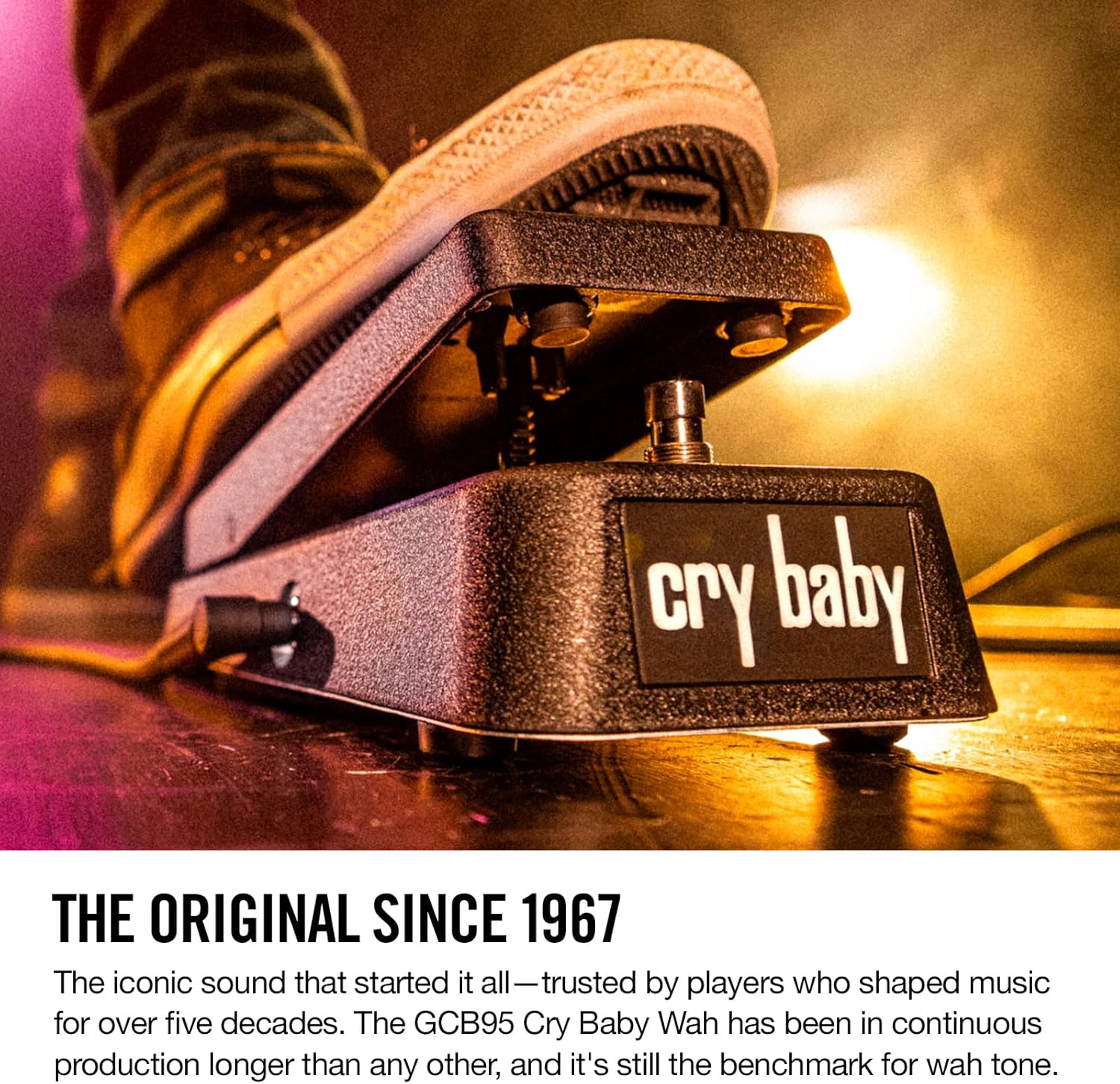
Buy this if you want a wah: The Dunlop Cry Baby GCB95 ($80) is the standard entry point — affordable, rugged, and widely available at major retailers and the used market. If you want the vintage-voiced inductor feel that session players and boutique players prefer, the Dunlop Cry Baby 535Q ($150) adds a tunable Q control that lets you dial in exactly how vocal or wide the sweep feels. For the players chasing the original ’60s Vox sound, the Fulltone Clyde Deluxe and the Xotic XW-1 both receive consistent praise in Guitar World’s “Best Wah Pedals” buyer’s guide for their inductor quality and sweep width.
Chorus
A chorus pedal takes your dry guitar signal, makes one or more slightly pitch-shifted, slightly delayed copies of it, and blends those copies back in. Because the copies are just slightly out of tune and time with the original, the combined sound feels wider, thicker, and — when dialed in gently — almost like two guitars playing together.
The key controls are rate (how fast the pitch modulation cycles), depth (how wide the pitch drift is), and on more sophisticated units, mix (how much wet chorus signal blends with your dry signal). MusicRadar’s “Best Chorus Pedals 2025” roundup consistently notes that the most common beginner mistake is setting depth too high, which produces an obvious, seasick wobble rather than the subtle, lush width that makes chorus actually useful in a mix.
By the numbers:
- Boss CE-2W (Waza Craft reissue): ~$180 street price, two-mode circuit, analog dry path
- Walrus Audio Julia: ~$200, adds a “lag” control for detune-style thickness
- TC Electronic Corona: ~$130, with TonePrint app for deep customization
- EHX Small Clone: ~$80, the chorus circuit behind Nirvana’s “Come as You Are”
The Boss CE-2W is widely cited — including in Premier Guitar’s “The Practical Pedalboard” feature series — as the most accurate recreation of the original CE-2 analog circuit that defined 1980s chorus tones. If your needs lean modern and you want flexibility, the Walrus Audio Julia earns consistent praise across aggregated reviews for its “lag” control, which lets you push the detuning effect into almost vibrato territory without a separate pedal.
Buy the CE-2W if you want the classic, studio-polished analog chorus sound. Buy the Julia if you want one pedal that spans chorus to vibrato with expressive control. Buy the Corona if you run a diverse setlist and want quick voicing changes from a smartphone.
Phaser
A phaser (short for phase shifter) splits your signal into two paths, shifts the phase of one path at specific frequencies (meaning it delays select frequencies slightly, without a pitch change), and recombines them. The cancellations and reinforcements that result as the phase cycles up and down create that signature swooshing, flanging-without-flanging quality you hear in Van Halen’s “Eruption,” Hendrix’s “Axis: Bold As Love,” and virtually every funk rhythm guitar part from the 1970s.
The two classic benchmarks are the MXR Phase 90 (four-stage phase, the tighter and more focused of the two) and the Electro-Harmonix Small Stone (four-stage with a slightly warmer, looser character). As Premier Guitar’s gear team has noted across multiple feature comparisons in their “The Practical Pedalboard” series, the Phase 90’s “Script” circuit (the original 1970s voicing, now available on the reissue Phase 90 Script) sounds rounder and less harsh than the later “Block” logo version — a useful distinction if you’re chasing vintage Hendrix or David Gilmour tones versus the more aggressive Eddie Van Halen application.
For players who want more control without a significant jump in price, the MXR Phase 95 ($130) combines the Script and Block modes in a mini enclosure. Premium territory is dominated by the Earthquaker Devices Grand Orbiter ($185) and the Source Audio Lunar (~$180), both of which offer expanded stage counts (four to eight stages) for richer, more complex phase movement.
Buy this if you want a phaser: Start with the MXR Phase 90 (~$80) if you want the classic voice without overthinking it. Step up to the Phase 95 if you want both vintage and modern voicings in one box. Move to the Grand Orbiter if you want phaser to be an expressive centerpiece rather than a background texture.
Signal Chain Order: Where These Pedals Live on Your Board
This is where most intermediate players start second-guessing themselves — and where getting it right makes a meaningful sonic difference.
The general consensus across Sweetwater’s “Modulation Effects Explained” knowledge base article and Guitar World’s pedalboard tutorials runs like this:
Guitar → Tuner → Dynamics/Compression → Gain/Overdrive/Distortion → Modulation (wah, chorus, phaser) → Delay → Reverb → Amp
A few practical notes:
- Wah before gain (overdrive or distortion) produces a tighter, more musical sweep because you’re filtering a cleaner signal. Wah after gain produces a fuzzier, more dramatic sweep that can feel less controlled. Neither is wrong — Hendrix ran his wah before a fuzz, which is part of why his tone sounds so thick. But “before gain” is the safer default.
- Chorus and phaser in the effects loop of your amp (if it has one) keeps them acting on your full, already-driven tone rather than going into the front of a dirty amp and getting muddied. This matters most for players using high-gain amp settings. For clean-to-light-crunch players, front-of-amp placement is usually fine and simpler.
- Running phaser and chorus simultaneously can turn into a swirling mud puddle fast. Use one at a time unless you’re deliberately chasing a specific textural effect (certain shoegaze and ambient players do this intentionally).
Budget Tiers and What You Actually Get
Here’s an honest breakdown so you know what you’re trading when you buy up or buy down:
| Tier | Price Range | What Changes |
|---|---|---|
| Entry | $50–$100 | Solid basic functionality; fewer controls; acceptable component quality |
| Mid | $100–$200 | Better inductors/capacitors; more voicing options; improved build longevity |
| Boutique/Premium | $180–$350+ | Top-shelf components; expanded controls; often hand-wired or small-batch |
The jump from entry to mid is meaningful — particularly for wah, where the inductor quality is genuinely audible. The jump from mid to boutique is real but narrower in functional terms; you’re often paying for build quality, component sourcing, and refinement rather than a completely different effect. Per aggregated player reviews compiled in MusicRadar’s “Best Chorus Pedals 2025” roundup and Sweetwater’s knowledge base coverage, most working guitarists find the mid tier “good enough for any gig” and reserve boutique spending for specific tonal goals they can articulate clearly.
The “If X, Then Y” Decision Guide
-
If you play mostly clean-to-light-crunch and want one modulation effect: Chorus first. It works in virtually every genre and adds width without calling attention to itself. Start with the EHX Small Clone (
$80) or the Boss CE-2W ($180) depending on budget. -
If you play classic rock, funk, or blues and want expressive lead tools: Wah first, then phaser. The Dunlop GCB95 plus a Phase 90 gets you through most of the classic American rock canon.
-
If you play ambient, shoegaze, or layered indie: Phaser before chorus in your chain. The phaser creates movement; the chorus adds width. The Earthquaker Grand Orbiter plus a Walrus Julia is a premium version of this pairing.
-
If you’re on a strict budget: One pedal done right beats three pedals done cheap. The Boss CE-2W or the MXR Phase 90 at $80–$180 each will serve you for years. Avoid splitting the budget across three weak pedals.
-
If you’re building a signal chain for live gigs: Prioritize the wah (highest real-time expressivity) and one modulation effect over delay or reverb — those can come from your amp’s onboard effects in a live context. Get the modulation tone right first.
Wah, chorus, and phase don’t need to be complicated. Each one does a specific job, and buying the right one at the right tier for your actual playing style — rather than the one that sounds impressive on a demo — is where intermediate players start making decisions that actually move their tone forward.